
Why the 3-Day Marrakech to Merzouga Tour Became Morocco's Classic Sahara Route
Discover how historic caravan corridors, High Atlas landscapes, southern Morocco's oasis valleys, and the Erg Chebbi dunes shaped the popular 3-day Marrakech to Merzouga tour.
Written by 3 Days Merzouga Editorial Team • Verified Sahara route operational advice
Why is the 3-day Marrakech to Merzouga tour so popular?
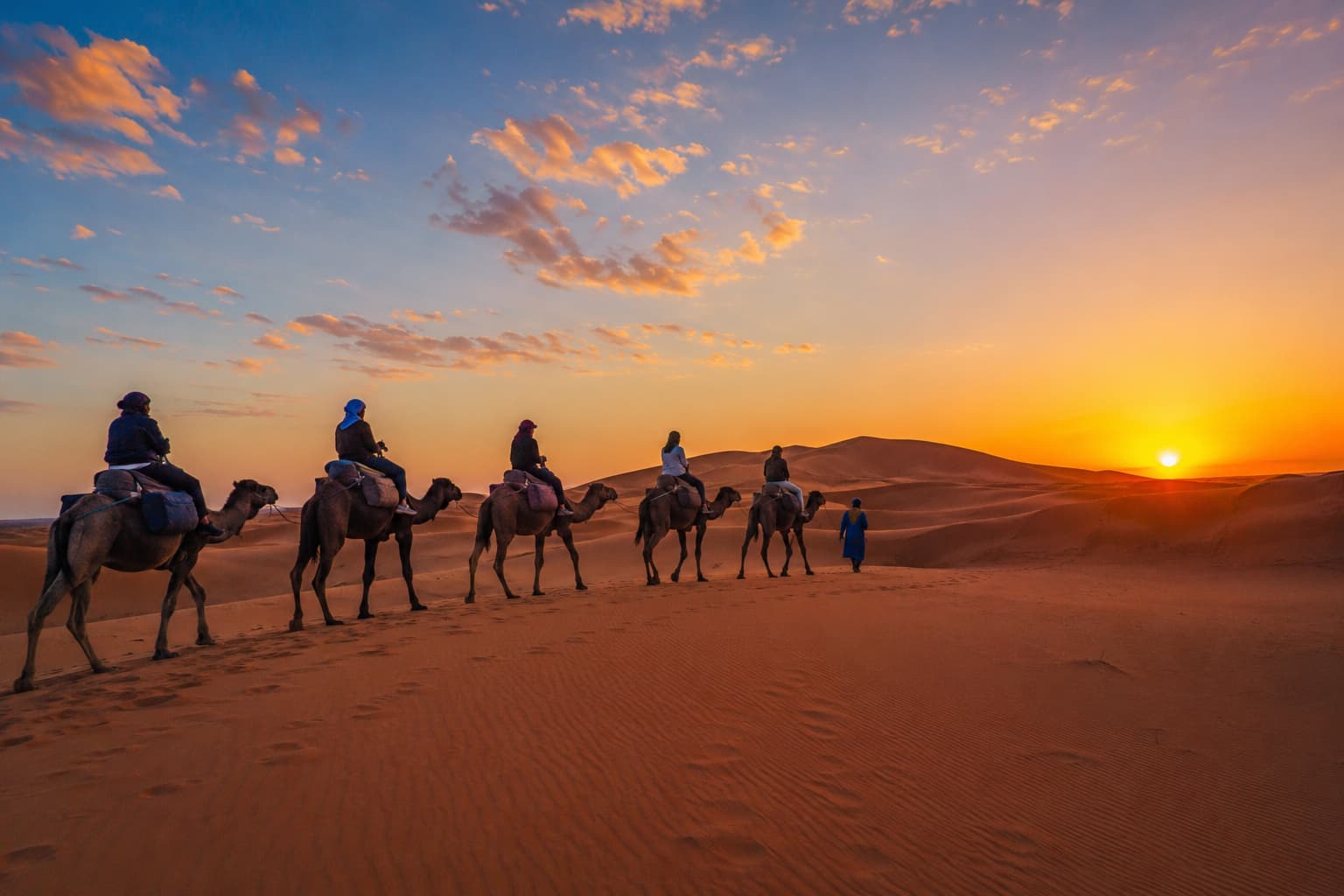
The 3-day Marrakech to Merzouga tour became popular because it turns a limited Morocco itinerary into a complete journey across several different landscapes. In three days, travelers can leave Marrakech, cross the High Atlas Mountains, see fortified villages and oasis valleys, reach the Erg Chebbi dunes, ride into the desert around sunset, and spend a night near the Sahara before returning to Marrakech.
Its appeal is not only the final night in Merzouga. The road links places with deep histories of movement, trade, farming, architecture, and settlement. The modern tour packages those layers into a route that is possible for visitors who cannot dedicate a full week to southern Morocco.
Is today's route an ancient caravan road?
Not exactly. It is more accurate to say that the modern Marrakech to Merzouga itinerary connects several historic corridors rather than following one unchanged caravan trail from beginning to end. Roads, passes, and overnight stops have changed, but the journey still crosses regions that linked Marrakech with pre-Saharan Morocco and connected oasis communities with wider trade networks.
That distinction matters. The present tour uses modern paved roads and comfortable vehicles, while the historic landscape survives in the ksour, kasbahs, markets, irrigated valleys, and settlements encountered along the way. Understanding the route this way makes the journey richer without turning history into a travel myth.
Crossing the High Atlas from Marrakech
Leaving Marrakech, the route climbs into the High Atlas and crosses the Tizi n'Tichka corridor toward Ouarzazate. The current road is a modern construction rather than a medieval caravan track, but the mountain barrier is ancient. For centuries, communities used a network of passes to move between the Marrakech plain and the valleys of southern Morocco.
Today the crossing is one reason the tour feels so dramatic. Red-earth villages, steep slopes, changing geology, and wide viewpoints replace the city within a few hours. It also explains why an experienced professional driver and a well-maintained air-conditioned vehicle matter: this is a long mountain-and-desert journey, not a simple transfer between two resorts.
Ait Ben Haddou and the old commercial landscape
Ait Ben Haddou gives travelers the clearest visible connection to the route's trading past. UNESCO describes the fortified ksar as one of the trading posts on the commercial route that linked ancient Sudan with Marrakech through the Draa Valley and the Tizi n'Telouet Pass. Its defensive walls, earthen houses, communal spaces, granary, and caravanserai show how travel, protection, storage, and daily life once met in southern Morocco.
The oldest surviving structures are not considered earlier than the seventeenth century, but the building traditions are older. A private tour allows time to understand the site as more than a film location: it was part of a working cultural landscape shaped by trade and local communities.
Dades Valley and Todra Gorge were lived corridors
The road east through the Valley of Roses, Dades Valley, and Todra is often described only in terms of scenery. Yet these valleys are also places where water made agriculture, fortified settlements, and movement possible on the dry side of the Atlas. Villages and fields follow rivers because the rivers supported life, not because they were designed as tourist stops.
For modern travelers, this creates the route's strongest contrast: mountain rock, green cultivation, earthen villages, palm oases, and increasingly arid plateaus appear in succession. The first hotel night around Dades also divides the drive into a more realistic rhythm before the approach to Merzouga on day two.
Tafilalt, Rissani, and the memory of Sijilmassa
Near Rissani, the journey enters the Tafilalt, a historic oasis region with a far larger role in trans-Saharan history than many short tours explain. The archaeological remains of Sijilmassa lie close to Rissani. Founded in the eighth century, Sijilmassa served for centuries as a major caravan port and commercial crossroads between the Maghreb and the Sahel before declining as trade routes shifted.
The dunes at Merzouga should not be presented as if every caravan passed through today's tourist village. The stronger historical connection is regional: Erg Chebbi stands near the Tafilalt oasis system and the northern edge of a world once organized around desert crossings, markets, fortified settlements, and long-distance exchange.
How Merzouga became an international destination
Merzouga's modern fame grew from its position beside Erg Chebbi, one of Morocco's most recognizable dune fields. Research presented on tourism in the village describes local settlement near the dunes from the 1950s and increasing international tourism from the 1980s, followed by growing domestic tourism from the 2000s. Guesthouses, desert camps, guided camel outings, and other local services developed around that demand.
Photography and online travel planning made the destination easier to recognize, but the landscape is the real reason interest endured. Erg Chebbi offers the high golden dunes many travelers imagine when they picture the Sahara, while Merzouga is reachable by road and can support camp stays, local guides, and organized transfers. Morocco's current tourism strategy also recognizes Desert and Oasis Adventure as one of the country's principal travel themes.
Why three days became the classic format
Three days is the shortest practical format that combines the major southern route with a genuine Erg Chebbi stay from Marrakech. Day one reaches Dades after the Atlas and kasbah region. Day two continues through Todra and the Tafilalt toward Merzouga. Day three returns to Marrakech by a southern route. It is still an energetic itinerary, but each night falls in a place that makes geographic sense.
A two-day Merzouga tour from Marrakech would compress too much distance into too little time. Four days is more relaxed and gives more time around the desert, but three days remains popular because it fits neatly between city stays and international travel schedules while still reaching the large dunes.
Why we operate this route only as a private tour
3 Days Merzouga operates private tours rather than shared departures. Your group travels with a professional team in a comfortable air-conditioned vehicle, without being combined with unrelated travelers. This gives the driver and guests more control over pickup, rest breaks, viewpoints, meals, walking time, and the overall pace of a long route.
Private travel is especially valuable for families, couples, photographers, friends, and travelers with specific accommodation or dietary needs. It also lets us customize the itinerary: camp category, room preferences, pickup point, return route, additional nights, and the balance between sightseeing and driving can all be discussed before departure.
What to expect from our private Marrakech to Merzouga tour
Our classic tour begins and ends in Marrakech and includes the High Atlas crossing, Ait Ben Haddou, the Dades region, Todra Gorge, Merzouga, an Erg Chebbi camel experience, and a desert camp night. Exact stops and timing depend on season, road conditions, your pickup location, and the pace agreed with your group.
The goal is not to race through a checklist. It is to make a demanding route feel organized and personal. If three days matches your schedule, view our 3-Day Marrakech to Merzouga Desert Tour and send us your dates, group size, preferred camp level, and any custom requests. We will confirm the route, private vehicle, availability, and price before you book.
Sources & further reading
- UNESCO World Heritage Centre: Ksar of Ait-Ben-Haddou
- French Ministry of Culture archaeology portal: Sijilmassa
- Moroccan National Tourist Office: Errachidia, Midelt and Merzouga
- Morocco tourism roadmap: Desert and Oasis Adventure
- Heritage and Tourism conference: the development of desert tourism in Merzouga
Editorial & Review Standards
This article is maintained by 3 Days Merzouga and verified against current southern Morocco road conditions, distance logs, and camp logistics.
Related desert travel guides
5 min read
3-Day Marrakech to Merzouga Desert Tour: What to Expect
A practical guide to the classic Marrakech to Merzouga route, including Ait Ben Haddou, Dades Valley, Todra Gorge, Erg Chebbi camel trekking, and a Sahara camp night.
6 min read
Best Time to Visit Merzouga: A Month-by-Month Sahara Guide
When is the best time for a Marrakech to Merzouga desert tour? A season-by-season guide to Erg Chebbi weather, camel trekking comfort, desert camp nights, and how to plan around the heat.
6 min read
What to Pack for a Merzouga Desert Tour: Sahara Packing List
A practical packing list for a Marrakech to Merzouga desert tour, covering layered clothing, footwear, sun and dust protection, overnight camp essentials, and what you can safely leave behind.